
Master carbide insert selection logic from substrate, coating, geometry and chipbreaker. Ocut CNC inserts deliver reliable performance for turning, milling, boring and drilling across steel, stainless steel, cast iron and superalloys.
How to Select Indexable Carbide CNC Inserts: Core Factors for Stable Machining & Lower Production Cost
In modern CNC workshops, indexable carbide inserts are the core consumable that directly determines machining quality, cycle time and overall production cost. Many machinists only compare unit prices when sourcing inserts, ignoring the matching of grades, coating and geometry, which easily leads to frequent chipping, rapid wear, poor surface finish and unstable batch production.
Ocut, focusing on high-performance CNC cutting tools, sorts out the key selection logic for indexable carbide inserts to help manufacturers conquer complex working conditions and maximize tool ROI.
 1. Substrate: The Foundation of Wear Resistance & Toughness
The main body of carbide inserts is tungsten carbide bonded with cobalt. The cobalt content and grain size decide the base performance:
Higher cobalt content: Better impact resistance, suitable for roughing, interrupted cutting and unstable clamping conditions.
Fine-grain carbide substrate: Higher hot hardness, good for continuous high-speed finishing and abrasive materials.
Following ISO classification, inserts are divided into P/M/K/N/S series for different workpieces:
P grade: Carbon steel, alloy steel, continuous turning
M grade: Stainless steel, duplex steel, general alloy
K grade: Cast iron, ductile iron
N grade: Aluminum, copper and other non-ferrous metals
S grade: Titanium alloy, nickel-based high-temperature alloy
2. Coating Technology: The Key to Extend Tool Life
Coating is the protective barrier on the insert surface, the most obvious difference between ordinary inserts and premium inserts. Two mainstream coating processes are widely used:
CVD Coating: Multi-layer structure including TiCN + Al₂O₃ + TiN. Excellent thermal barrier performance, anti-crater wear, preferred for high-speed continuous steel turning.
PVD Nano Coating: Thinner coating layer, sharp cutting edge, low friction. It effectively suppresses built-up edge, ideal for stainless steel, titanium alloy and finishing operations.
Ocut optimizes coating adhesion and stress control, reducing coating peeling under high temperature, so the inserts maintain stable cutting performance for longer running time.
3. Geometry & Chipbreaker: Control Chips & Reduce Cutting Vibration
Insert shape, rake angle and chipbreaker groove are designed for specific cutting scenarios:
Negative rake inserts: Strong edge strength, widely used for heavy roughing and interrupted cutting.
Positive rake inserts: Lower cutting force, less heat generation, perfect for sticky materials and precision finishing.
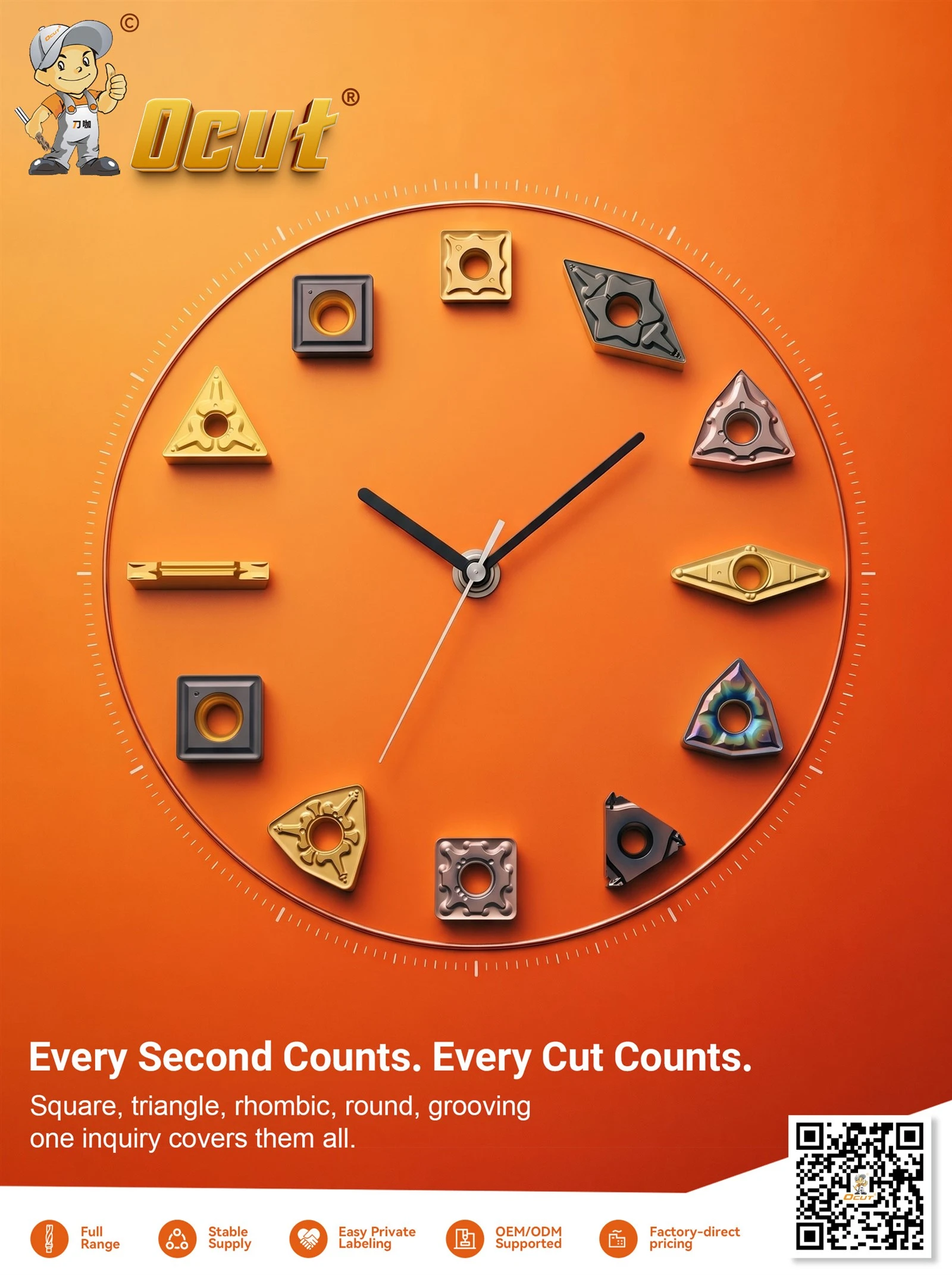
Common shapes: CNMG (80° rhombus), SNMG (square), TNMG (triangle), RNMG (round), VBMT (35° rhombus for profiling).
Different chipbreakers control chip curling and breaking. Improper chip groove selection will cause tangled chips, scratch the workpiece surface and even break the cutting edge.
4. Operation Matching: Turning, Milling, Drilling & Boring
One insert cannot fit all machining types.
Turning inserts: Focus on continuous chip control and flank wear resistance.
Milling inserts: Must withstand repeated impact of entry and exit, priority on toughness and anti-chipping ability.
Boring & internal machining inserts: Require sharp edge and small cutting force, limited by the inner space.
Ocut's full series CNC inserts cover turning, milling, drilling and boring, with diversified geometries and grades to adapt to multi-scene machining demands.
5. Common Failure Causes & Optimization Tips
Edge chipping: Too large feed, insufficient substrate toughness, machine rigidity is poor → Switch to tougher grade or reduce cutting load.
Rapid flank wear: Cutting speed too high, coating not matched with workpiece → Select high-temperature resistant CVD grade.
Built-up edge (BUE): Material adhesion on edge, bad surface finish → Use low-friction PVD coated inserts and increase coolant flow.
Vibration & chatter: Unreasonable nose radius, overhang too long → Reduce corner radius and improve clamping rigidity.
Final Words
A suitable carbide insert is not the most expensive one, but the one matched with your workpiece material, cutting method and machine condition. Stable cutting, long service life and consistent precision are the core value of high-quality cutting tools.
Ocut keeps optimizing substrate formula and coating technology, providing reliable indexable carbide inserts for global machining workshops. Whether you are doing mass production roughing or high-precision finishing, we can offer grade recommendation and cutting parameter support.
Contact our team for catalog, sample test and technical consultation.
Contact Info
Winnie Wang | Sales Manager
WhatsApp & WeChat: +8615163782196
Email: 6196@ocutchina.com
Website: www.ocutooling.com
Precision in Hand, Confidence in Ocut®


