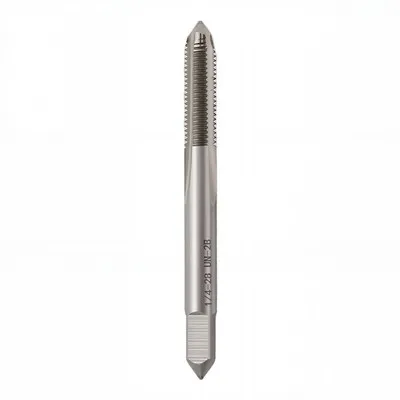
Hey there! As a hand taps supplier, I often get asked some pretty interesting questions. One of the most common ones lately is, "Can hand taps be used on glass - filled plastics?" Well, let's dive right into it and break this down.
First off, let's talk a bit about glass - filled plastics. These are plastics that have glass fibers added to them. The addition of glass fibers gives these plastics some really cool properties. They're stronger, more rigid, and have better dimensional stability compared to regular plastics. You'll find glass - filled plastics in all sorts of applications, from automotive parts to electrical components.
Now, when it comes to hand taps, we've got a few different types. There are Spiral Flute Hand Taps, Straight Flute Hand Taps, and Spiral Point Hand Taps. Each type has its own unique features and is designed for different situations.
Let's start with whether hand taps can be used on glass - filled plastics in general. The short answer is yes, but there are some important things to keep in mind. Glass - filled plastics are abrasive because of the glass fibers. This means that the hand taps can wear out faster compared to when they're used on regular plastics or softer materials.
Spiral Flute Hand Taps are great for this kind of job. They have a spiral shape that helps to evacuate the chips as you're tapping. In glass - filled plastics, the chips can be sharp and abrasive, and if they're not removed properly, they can cause damage to the tap and the threads you're creating. The spiral design of these taps allows the chips to be pushed out of the hole, reducing the risk of clogging and improving the overall tapping process.
Straight Flute Hand Taps, on the other hand, are more basic. They're simple and easy to use, but they might not be as effective when it comes to dealing with the chips in glass - filled plastics. The straight flutes don't have the same chip - evacuation capabilities as the spiral flutes. So, if you're using straight flute hand taps on glass - filled plastics, you might need to stop more often to clear the chips manually.


Spiral Point Hand Taps are another option. These taps are designed to push the chips forward. They're often used for through - holes. In glass - filled plastics, they can work well if you're dealing with through - holes because they can effectively move the chips out of the way. However, for blind holes, they might not be the best choice as the chips can get trapped at the bottom of the hole.
Now, let's talk about some of the challenges you might face when using hand taps on glass - filled plastics. As I mentioned earlier, the abrasiveness of the glass fibers is a big issue. This can lead to rapid wear of the tap. To combat this, you need to choose the right material for your hand taps. High - speed steel (HSS) taps are a common choice, but for glass - filled plastics, you might want to consider carbide taps. Carbide is much harder and more wear - resistant than HSS, so it can withstand the abrasive nature of the glass - filled plastics better.
Another challenge is the risk of cracking or chipping the plastic. Glass - filled plastics are more brittle than regular plastics. When you're tapping, you need to apply the right amount of force. Too much force can cause the plastic to crack, while too little force might not cut the threads properly. It's all about finding that sweet spot.
You also need to pay attention to the lubrication. Using a good lubricant can make a huge difference. It reduces friction, which in turn reduces the heat generated during the tapping process. Heat can cause the plastic to melt or deform, and it can also speed up the wear of the tap. A lubricant like cutting oil or a specialized tapping fluid can help to keep everything running smoothly.
When it comes to the tapping process itself, start with a pilot hole. This helps to guide the tap and reduces the risk of the tap wandering or causing damage to the plastic. Make sure the pilot hole is the right size. If it's too small, the tap will have to work harder, which can lead to more wear and a higher risk of cracking the plastic. If it's too big, the threads might not be as strong.
Now, let's sum it all up. Hand taps can definitely be used on glass - filled plastics, but it's not without its challenges. You need to choose the right type of tap, the right material for the tap, and use proper lubrication. You also need to be careful with the amount of force you apply and start with a well - sized pilot hole.
If you're in the market for hand taps for glass - filled plastics or any other applications, we're here to help. We've got a wide range of high - quality hand taps, including Spiral Flute Hand Taps, Straight Flute Hand Taps, and Spiral Point Hand Taps. We can provide you with the advice and products you need to get the job done right. If you're interested in learning more or making a purchase, don't hesitate to reach out and start a procurement discussion.
References:
- "Plastics Engineering Handbook", Various industry experts
- "Tapping Techniques for Different Materials", Industry research papers